
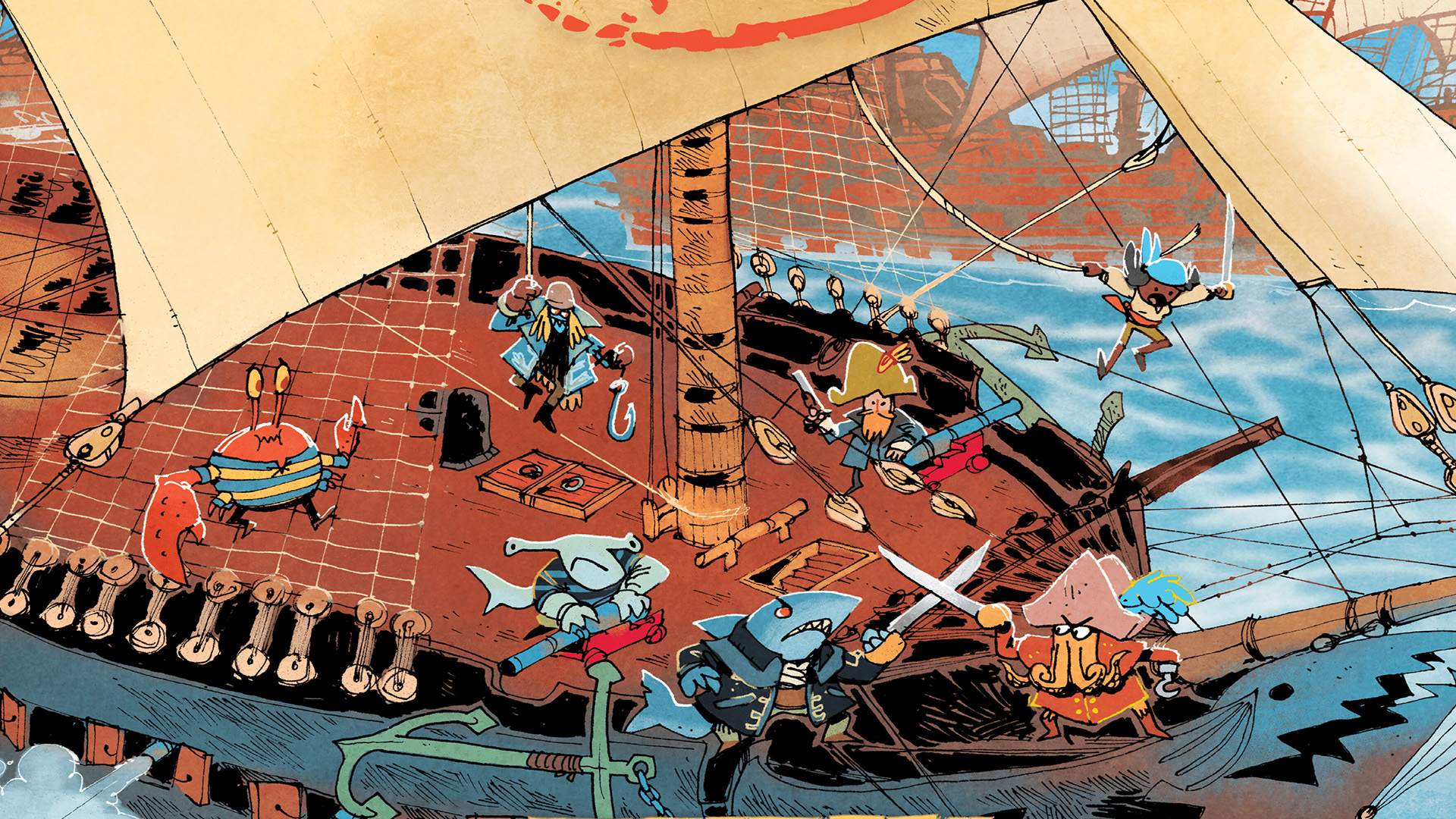
Ahoy matey! Let’s talk about Ahoy, matey. Sorry, that’s the best pirate joke I’ve got today. But seriously, let’s talk about Ahoy.
Ahoy is an asymmetrical strategy game from the makers of the asymmetrical strategy game, Root. For those unfamiliar with the term, it means the players are doing something to play the game differently from one another. In many games, that something is a unique ability that differs between players. Ahoy has that, but goes even farther into asymmetry. Players one and two have unique abilities and strategies, and play an area control game. Players three and four differ from one and two, and are playing a pickup and deliver game. If you don’t know those terms, don’t worry about it. The point is that there are major differences between how players will approach the game.
There are, however, plenty of similarities as well. Players all start the round by rolling a set of action dice. On their turn, players place one die in an action space on their player board. Common actions that all players have include Sail (which moves a player’s Flagship one or two spaces on the map and Tailwind (which moves a Flagship to another numbered space matching the die placed). Players can also Load Cannons (preparing for Battling) or Repair damage done while Battling. If a Flagship is at an Island, that player can recruit Crew by paying their cost.
The Bluefin Squadron has unique Patrols and Strongholds. Whenever the Bluefin player takes the Sail or Tailwind action, they may place a Patrol in the space they end. Whenever a Patrol takes damage for any reason, it is removed from the board and goes back into the player’s supply. If there are two Patrols at an Island, the player can remove them and place a Stronghold on the Island. Strongholds always have loaded cannons, get an automatic +2 to their roll, and the player can still reduce their loaded Cannons die to further increase this bonus. Like Patrols, Strongholds go back into the player’s supply when damaged. The Bluefin Squadron can recruit crew matching a Stronghold’s Island’s suit as if their flagship were there. Their opponents, however, cannot recruit Crew, smuggle, or deliver Cargo to that Island. While all of this may seem powerful, the other players have even cooler powers, so the Bluefin player gets to place a fifth die on their board each round.
The Mollusk Union excels in area control. Whenever they take a Sail or Rally action, they can take Comrade tokens from their supply and place them into the Ready Comrades section of their board. Taking a Sail, Inspire, or Assemble action allows them to take Ready Comrades and place them onto Islands, giving that player +1 control in that space. Comrades are only tokens and cannot Battle on their own. The Mollusk Union also has plan cards that they draw after each round and play based on the card. Some cards impact Battles, while others impact movement. Two of the cards also allow the player to remove two Comrades from an Island and place their Cutter or Gunship there instead. These ships can only take Sail or Tailwind actions and can only take limited damage. The Gunship always has loaded Cannons with an automatic +3 to its combat roll. The Cutter, on the other hand, cannot load cannons at all. Rather, it gives any Comrades at its location +2 control instead of +1.
The third and fourth players take on the role of Smugglers. Smugglers can take a card from the market whose top icon matches the Island they are at’s suit. Then they need to travel to an Island matching the suit icon at the bottom of the card. This not only earns them Fame points, but also increases the wealth die for that Island, which benefits the Bluefin or Mollusk player who controls that Island. The Smuggler also gains a reward from their player board and pledges that cargo to either the Bluefin Squadron or Mollusk Union, potentially gaining more fame at the end of the game based on which players control what Islands.
Leder Games are the undisputed masters of asymmetrical games, and Ahoy just reinforces that reputation. I’m excited to play this again with some of the faction expansions and the Treasure Pack. I think that will be the true measure of this game: how well does it stand out with other mechanics shuffled into it? When a game like this feels like it’s gone sideways, it’s a LOT harder to pin down the cause. The Mollusk Union won all of our games and felt somewhat overpowered. But is that really a balance issue, or is it a better player who caught on to the intricacies of their faction faster than the other players? While we felt like it was the former at the time, I suspect it’s the latter. I was playing the Bluefin Squadron, and I think I needed to play more aggressively than I did. Will swapping the Mollusks out for The Leviathan from Fang & Fortune or the Shellfire Rebellion from Rivals and Renegades solve that problem, or will it dig up a new treasure chest of issues? (For the record, I suspect it will show the strength of the game, more than it will bring up new difficulties.)
The hardest part about Ahoy –and, indeed, most asymmetrical games– is that it can be a challenge to teach new players how to handle different factions and to learn them yourself. But I believe that, like Root and Vast before it, Ahoy is worth the trouble to learn and play. I’m excited to try out the expansions and play more Ahoy.
BONUS REVIEW
The Ahoy Treasure Pack is a fascinating mini expansion for Ahoy. The tuck box (which fits in the Ahoy box if you pack it right) contains lucky-13 Treasure cards and the tokens and die that may be needed by a player using a Treasure card. After setting up the game and choosing factions, each player draws two Treasure cards and chooses one to keep and use for the game.
The cards all present fantastic new player powers, increasing the asymmetrical basis of the game. Some of the highlights include:
Ghostly Gang, which allows the player to place a unique third die on their action board, damaging that die slot when it is removed.
Ancient Malediction, which allows the player to add an additional Corruption token on an opponent’s board after defeating them in Battle. Corruption tokens require two Repair actions to fully repair.
Jar of Land & Sea, which allows the player to place or remove a Sandbar terrain token on the board, or a Water terrain token (covering a Sandbar already on the map tile).
Not all of the cards have new components. Most use the regular components.
Gambler’s Dice awards a bonus 1, 2, or 4 Fame points for rolling 2, 3, or 4-of-a-kind on your action dice, but penalizes 1 Fame if you roll snake eyes (two 1s)
Spectral Sail allows the player to ignore all terrain when moving their Flagship, but they lose 3 Fame at the end of the game.
Any asymmetrical game has a high replayability factor. But the Treasure Pack is an economical way to increase the unpredictability of your game, ensuring a new game experience every time.
You can find Leder Games online at ledergames.com or on Facebook at facebook.com/LederGames.
[David Chapman]