
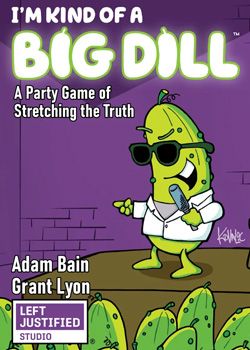
How would you describe your skill at driving a moving truck? How would you describe your ability to make friends with woodland creatures? How would you describe your love of finger guns? Odds are that you are lying, but the real question is, can your friends tell how you are lying? They can ask you questions, but come the Moment of Truth, they have to guess if you are exaggerating or downplaying your answer and by how much.
That’s the premise of the party game, I’m Kind of a Big Dill. It’s not just about telling if “The Big Dill” is lying, because the odds are 6/7 that they are. You see, The Big Dill starts their turn by picking one of two prompts and drawing a hidden Exaggeration Token. That token tells them how to answer the prompt. If it’s 0, they tell the truth. If it’s +1, +2, or +3, they exaggerate their answer. If they draw a -1, -2, or -3, they downplay their answer.
That sounds simple, right? But think of it like this: It’s hard to overstate my love of classic Saturday morning cartoons. I would wager that most of my friends know me well enough to know, or at least assume, that about me. So if I’m asked to describe my love of Saturday morning cartoons and say “they are the worst thing ever and rotted kids’ brains,” most people would probably guess -3. But I could say that “the loss of Saturday morning cartoons was akin to cultural genocide.” I’m not so sure those same friends would guess +1, +2, or +3. I could probably write an academic paper on that answer, but it’s probably only a +2 for me.
Thankfully, players are given the chance to get a better gauge on my answer, and may each ask one question. This is the biggest impact of playing with a larger group versus a smaller group. Playing with a larger group means more questions, and theoretically more opportunities to dial in on The Big Dill’s opinion.
After everyone has asked their question, they mark down how they are being lied to (+/- 0-3). Then comes The Moment of Truth and the big reveal. Players who guessed exactly correctly get two points. Players who were only off by one still get one point. The Big Dill gets two points if at least one, but not all, of the players guess correctly. When players mark down their guesses, they also have the option to wager “Bold Slices” that they are confident they are dead on correct. If they are correct, they get an extra point for each Bold Slice wagered. (up to three for the whole game.) The gamble is that if they were wrong, they automatically score zero for that round. It’s all or nothing, baby!
I run in some pretty outgoing social circles, so this is a good game for us. But for some groups, this game poses a challenge. Everyone gets a turn in the spotlight, and not everyone likes a turn in the spotlight. Some of the more popular party games allow a person to be outrageous by playing cards, but don’t require them to be a major focal point. This game encourages interaction by asking and answering questions. When you are The Big Dill, you are in the hot seat and need to come up with answers to all sorts of questions. Some people thrive in that environment. Others haaaaaaate that. That said, I would hope that whether you are playing this with friends or family, you are playing with people that you have a vested interest in being nice to and working with them to enjoy the game. There is absolutely no reason a person can’t sit there and make their guess without asking questions. There’s no reason to force them to be The Big Dill when it’s their turn. But with kindness and understanding, maybe that quiet person will feel comfortable coming out of their shells a little.

The core game comes with enough dry-erase pens and “Dill Meters” for up to ten players, with each of the three expansions (After Dark, Gets Nerdy, and Holiday) adding supplies for two more players. You can play this with pretty much any group. Although you may not want to play After Dark at family game night…
You can find Left Justified Studio online at left-justified.com or on Facebook at facebook.com/LeftJustifiedStudio.