
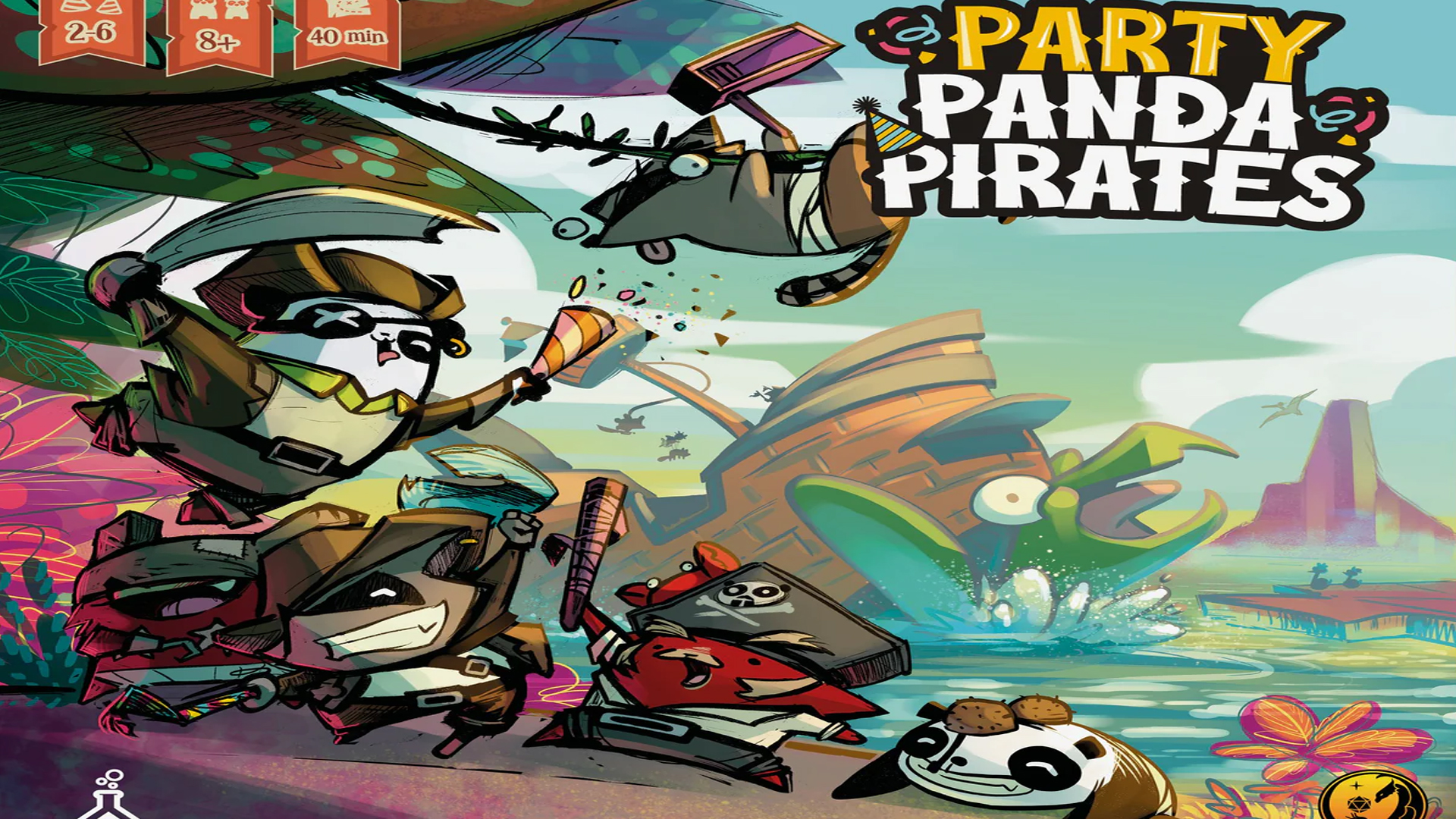
Y’arr mateys! Welcome back into The Rat Hole. TheRatHole.ca is pleased to be bringing ye landlubbers another great review! Today we be bringing you Party Panda Pirates! Now say that 5 times fast with a pirate accent. How about without a pirate accent? No, really, practice your “Party Panda Pirates” because it could be a mini-game you’ll have to play. (party 024 – Partly Irrate Penpals!)
Mini-game? That sounds an awful lot like Nintendo’s Mario Party! Well, you’re not wrong. Party Panda Pirates is inspired by, and structured very much like a tabletop version of, Mario Party.
Here’s the pitch:
“Sailing the Avian Archipelago, a turtle ship manned by panda pirates travels in search of parties.
Join the festive crew of the seas and participate in challenges of all kinds that will bring you unforgettable memories and friends. Sail along with the cheerful crew of Party Panda Pirates.”
I know that doesn’t say much about the game, but I love that such a ridiculous game has an established backstory.
The game starts with each player selecting one of three random party cards and placing it next to one of the islands on the main Sea Board. There are two sides to the board: a simplified board with three large islands and a more complex board with six smaller islands. Regardless of the map and player count, there will end up being six party cards placed next to the board. In the centre of the board, sits the turtle ship. (No, that wasn’t just for the lore.) This is a large model that looks like a… well… a turtle ship. The bow of the ship is an open-mouthed turtle head. The deck of the ship is on the back of the turtle. On the deck is a crow’s nest and a cannon. Here’s what’s neat: The cannon and turtle mouth are connected like a slide. The players use this to launch their panda pirate-shaped meeple towards the islands.
Once the board is ready, the player with the Captain (starting player) marker will use the turtle ship to slide their panda onto any island they choose, then every other player does the same. This is another way that the two maps differ. Each island has a circular target on it. On the simple map, all three are roughly in the centre of the island and all the same size. Any player who is touching the target after all the pandas have been played gets a coin. On the more complex side, the targets are in different locations on each island and are different sizes. Each panda that is touching the target receives a reward based on which island they are on. These rewards range from coins or a treasure chest to bonuses on the Treasure Map.
Since I’ve mentioned it, I’ll skip ahead to the Treasure Map because it’s important. After each party comes a treasure hunt. Starting with the winner of the just-finished party, players roll a die and move one of the paths on the Treasure Map. The paths lead to two possible treasure chests, and once a treasure chest has been collected, a new chest appears at the next of five numbered spaces. By moving the chests around like this, it adds some friendly frustration to the game, while also making it easier to stay competitive even when you lose the party games. You always know where the chests are and will be. After all six party cards have been completed, the player with the most treasure chests is the winner.
I’ve talked about the beginning. I’ve talked about the end. So that only leaves the middle. Just like in Mario Party, the treasure hunt is a mini-game that helps glue the rest of the mini-games together. But it’s the mini-games that make the overall game what it is. As it is with Mario Party, so it is with Party Panda Pirates. The mini-games are called “parties,” and this version of the game comes with 24 of them. Several expansions and promo cards increase that number, but 24 still gives you a good amount of replayability. Each party has an oversized card with a number, the game title, and a summary of what that game is. These are the cards I talked about earlier that players select at the beginning of the game. Once the party has been determined, there is a booklet with more detailed rules in it, as well as a QR code to a one minute how-to-play video.

The games are mostly dexterity based, but are still very different from one another. Some are just where you are sitting, and others make you stand up away from the table. For example, party 003 Confetti Cannonballs! has you stand about 2 meters (6 feet) from the table and throw square cards into the box lid on the table. Party 015 Cake Headache has you use those same cards to build a tower of dice and cards in front of you. Some parties are verbal, like party 024 – Partly Irrate Penpals! or 020 Yo Ho, Yo Ho! A Panda’s Life For Me! in which the group builds a sequence out of the words Ahoy, Yay, Yo Ho, and Yarr. As long as you’re willing to be a bit silly, they are all great!
The game is rated ages 8+, but is still super fun for adults. For a first game, I’ll often combine the two sets of map rules and give a coin instead of the advanced rewards on the advanced map.

Now, I was originally planning to hold this review back until International Talk Like A Pirate Day. But out of pure good timing, Party Panda Pirates Pandapalooza went live on Kickstarter literally as I was in the middle of writing this. Pandapalooza is a “grand expansion” with new mini-games, a new Treasure Map board, new items to increase player interaction, and three new stand-alone card games. With pledges as low as only $20 (USD) it’s the perfect time to pick up both the original game and a bunch of new goodies!
Party Panda Pirates Pandapalooza is live on Kickstarter until July 23, 2025.
You can find Draco Studios online at dracostudios.com or on Facebook at facebook.com/DracoStudioshius Entertainment online at modiphius.com or on Facebook at facebook.com/Modiphius.