
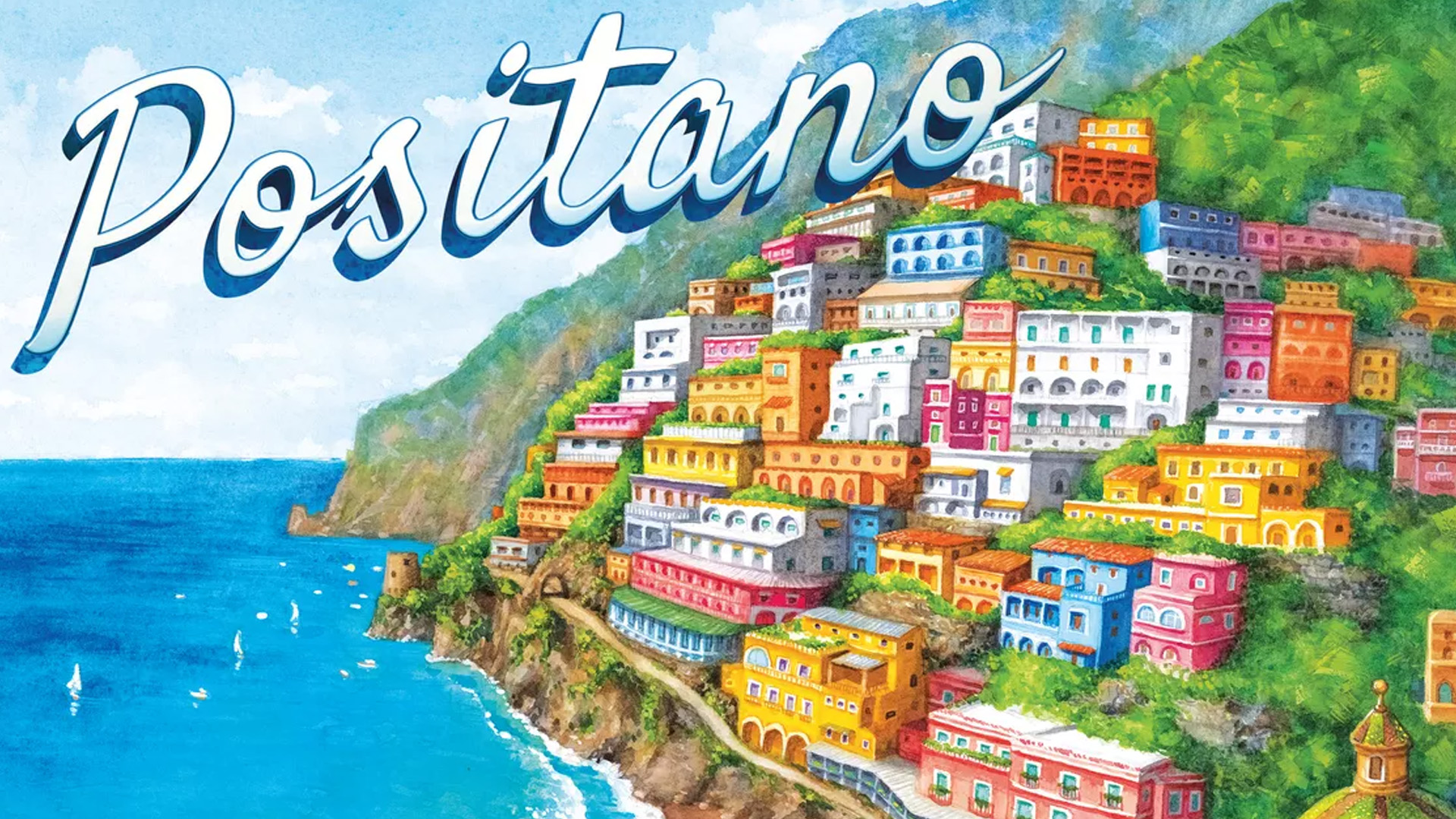

Look up Positano, Italy. Go ahead, we’ll wait. Go see why Positano is considered one of the most breathtakingly beautiful destinations in the world. Brightly, but tastefully, painted buildings scale a steep cliff, overlooking the ocean. Now imagine having another building spring up in front of your ocean view. What are you left with? A small home with awkward access and no view. No win for you.
That’s the basic premise of Positano, the game. Players bid on locations and resources to build the picturesque cliff of Positano. If your opponents builds in front of you, you get no points. Points are scored based on the view from 90º face on not top down. It’s a simple premise. It’s a simple premise, and the execution is just as simple.
Tiles representing lot numbers, the number of building blocks, and construction height are laid out one per player. Players all have an identical hand of bidding cards and modification cards. The bidding cards have a number for each type of tile. When you play a card, you are bidding on all three resource tiles at the same time, so you need to evaluate what your priorities are each round. You place a bid and add a modifier card, with the totals being your final bids for the first pick of any resource you win. The second highest gets the second pick, and so on.
The lot tiles determine where on the tiered 4×4 grid you’ll build. Remember, you only score points for building segments that are visible from the side of the board.
The block tiles determine how many blocks you take from your supply to build with.
The construction tiles determine a few things. First, it determines the maximum number of blocks you can use to build. But you can also only build a number of blocks equal to or less than the lot number you are building on. However, some construction tiles allow you to break that rule and increase the height of your buildings (assuming you have the blocks for it). The construction tiles also determine the roof of your building (bronze, silver, or gold), which acts as a point modifier (1x, 2x, or 3x).
All of these variables makes what is mechanically a very straight forward game into something much more strategic. It’s still straight forward though, and the limited board space keep the pace up. You’re looking at 30 minutes or less for a single game. The one thing that slowed us down was a situation where the winning bids by two players were identical. We couldn’t find an
answer about tied bids, so we made up a fair answer.
The gameplay is a ton of fun, and that’s enough. But the production value is unmatched, and that makes this game shine. It would be very easy to create building blocks that just stack. But these blocks fit together perfectly. They are easy to snap together and easy to snap apart, but they stay together like Lego. It’s very easy to pick up and set down a building once it’s assembled, making it easy to slip in between other buildings without knocking things down.

The game has a functional solo mode, but it just isn’t the same. The AI Player, Otto, lacks the finesse of a real player, and this game plays better at 3-4 players, in my opinion. There is a 5-6 player expansion available (which I have but haven’t cracked out as I write this), which adds two more players and comes with a bigger cliffside board to accommodate the extra players. The
bigger board also allows for a longer 4 player game and an expanded solo mode, as well.
The table presence is incredible. The gameplay is easy and fun. What more do you need to know? Positano is overall a great game.
You can find Slugfest Games online at slugfestgasmes.comor on facebook at facebook.com/SlugFestGames.