
Let’s start with a couple of disclaimers. First, the version of Rainbow Blvd I played (and streamed) was a prototype. Anything and everything I experienced could change. I know for a fact that the components I played with are changing in material and look, but not in function. Second, as I write this, I don’t have the exact date of the Kickstarter campaign. The hotlinks provided go to the campaign page, where you can be notified on launch or, if the campaign is live when you’re reading this, back the game.
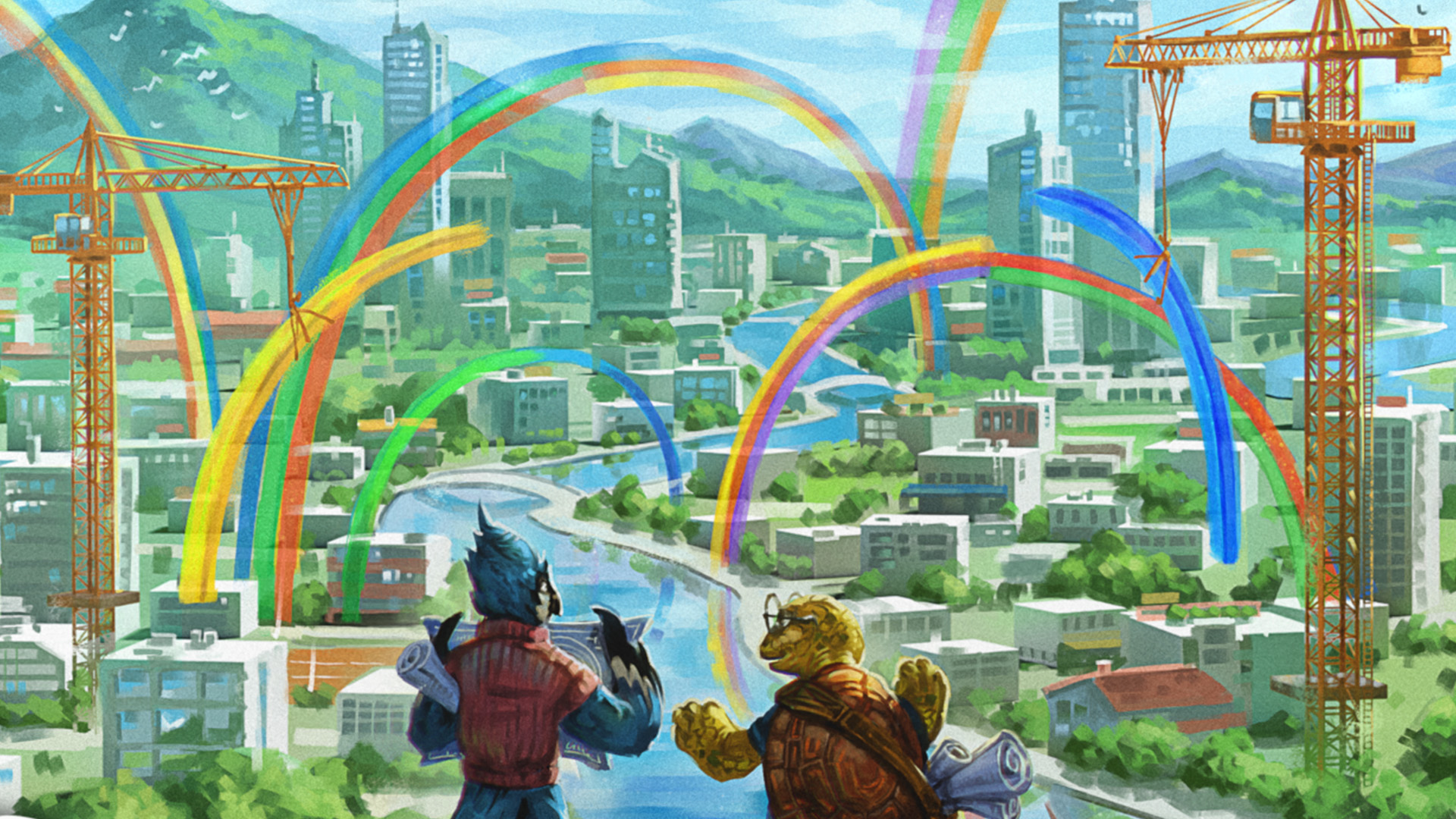
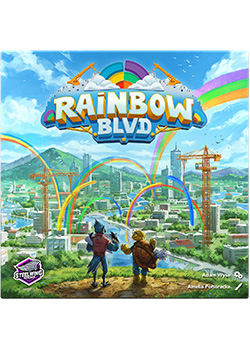
Rainbow Blvd is a great game of rainbow building, time management, and market manipulation. While that may sound like a lot, it’s actually extremely straightforward.
The game is played over a series of days (depending on the number of players), with each day broken down into hourly time slots on the time track at the top of the board. Each day runs from 7:00 am to 6:00 pm. If you go past that, and you will, the time you end in the evening is the time you begin in the morning of the next day. For example, if you end your actions at 9 pm, you’ll begin the next day at 9 am. This is important, since the player farthest back on the time track is the player who gets to take an action.
Every action you take moves you ahead on the time track. As the game progresses, the actions you can take often cost more time. The most common action is going to be building segments of a rainbow. Building half an inner arc takes 1 hour. Building a full inner arc takes 2 hours. Later in the game, building larger segments takes more time. The outermost arc takes a full 6 hours to build and requires all segments below it to be built first.
At the start of the game, each player begins with four blueprint cards. At the beginning of each day, players may choose to draw one to four new blueprints. Completed blueprints score you points at the end of the game, but incomplete blueprints penalize you. There are two main categories of blueprints. First are rainbow blueprints. These show a composition of rainbow segments, and score as soon as the shown combination is built. (Even on your opponent’s turn.) The second type is geographical. This is when there are specific coloured segments in multiple rainbows, in specific areas of the board. You might need a green segment in three rainbows adjacent to one another along a road or in the river.
The other major action you can take is drawing new contract cards. For 3 hours, you can draw two cards and keep one or for 5 hours you can draw three cards and keep two. Unlike blueprints, you’re not penalized for unfinished contracts at the end of the game. To complete a contract, the market must meet the requirements shown on the card. (I’ll tell you about the market in a moment.) The most basic contract is two colours in specific relation to each other. (Less than, greater than, or equal to.) More complicated contracts might have one colour at the highest in the market, and another colour the lowest. The more frustrating contracts integrate other colours. Red is greater than blue, which is greater than yellow, which is greater than green. Contracts also have stamps printed on them, and there is a set collection bonus for those stamps on completed contracts at the end of the game. Contracts are segmented, top and bottom, and you choose which side of the contract to fulfill. Usually one side will be harder and worth more points than the other.
So, what is the market? The market is in constant flux and is based on the topmost rainbow segments on the board. The rainbow bases on the board each have two colour segments, and when you build a new rainbow segment, one or both of those colour segments get covered up. The market then adjusts: if you covered a blue segment with a red segment, blue would go down one in the market, and red would go up one. So, with every new rainbow segment, the market shifts and another contract could score.
The market doesn’t start evenly every game. During setup, six small rainbow segments are randomly placed with the market adjusting appropriately. Yes, you could score a contract immediately after setup.
I’m very lucky that designer Adam Wyse is somewhat local to me, and I have had the opportunity to play previous iterations of Rainbow Blvd. I’ve been able to see it grow from a cool concept into a legitimately great game. Rainbow Blvd is as challenging as it is colourful. Yet it’s straightforward enough for a wide range of players to learn and enjoy. I do not doubt that the Kickstarter campaign will be a smash success, and I’m excited to see this game go out to the masses.
If you want to see Rainbow Blvd played (you do), we streamed a playthrough HERE.

Rainbow Blvd is coming soon to Kickstarter.
You can find Steelwing Games online at steelwinggames.com or on Facebook at facebook.com/SteelwingGames.