
“Gateway” games sometimes get a bad rap. They are too bland. They are too simplistic. But sometimes simple is all you need. Simple can be addictive. Flip 7 is addictive.
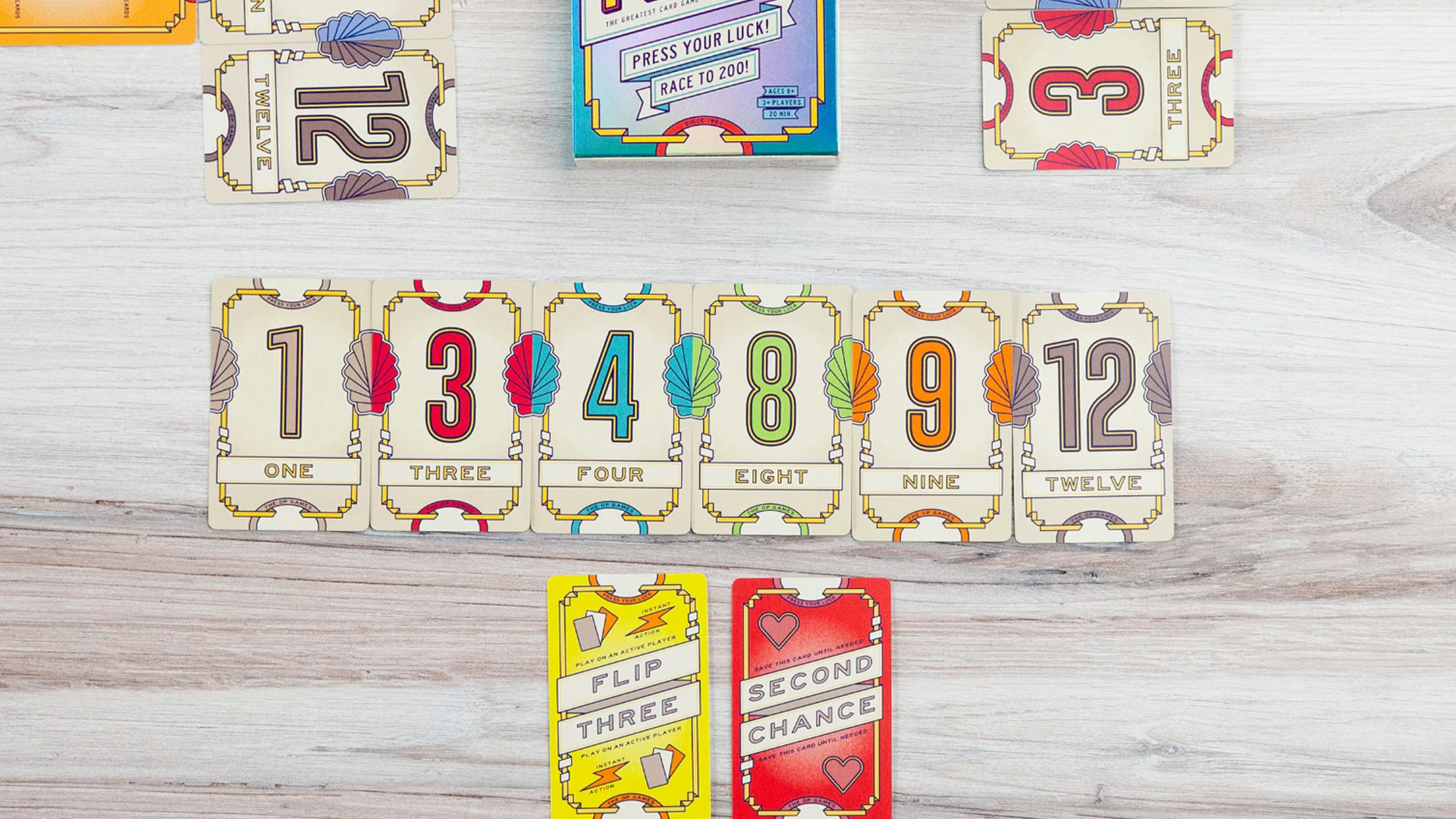
A Flip 7 deck is primarily a triangularly built deck. It has one 1, two 2s, three 3s, up to twelve 12s. Add to that +1 to +10 point cards, 2x point cards, and a handful of special action cards. There’s some math, but it’s pretty straightforward.
The dealer deals out one card to each player. If a special action is dealt, you resolve it immediately. Then each player has a choice to make, Hit or stop and Bank their points. If they Bank their points, they total up all of the number cards in front of them and add any bonuses. If they Hit, they get another card and potentially more points. I say potentially because if they draw a duplicate number card, they Bust and take zero points for the round. This continues until every player has either Busted or Banked their points. OR –there’s an or– if a player manages to draw seven unique number cards, they stop, Bank their points, and get a +15 point bonus on top of their total. That may seem simple, but remember that there are twelve 12 cards in the 94 card deck. So, the higher the cards you have in front of you, the more points your hand is worth. But the higher the cards you have in front of you, the higher the chance you’ll draw a second card and bust.
As I said before, there’s some math, but it’s pretty straightforward. The push-your-luck element always keeps things interesting, and flipping seven is always cause for celebration.
Flip 7 has seen strong sales, and recently, The Op has released several variants. There’s a Grinch edition for the holiday season, a Liquid Death themed edition (with exclusive extra actions), and a National Parks edition. There’s also a sequel game: Flip 7 With A Vengeance. The sequel features the same basic gameplay, but with extra cards. Most of the extra cards add player interactions that the original version lacks. Stealing and swapping other players’ cards, or forcing them to draw or discard cards. There are also negative score modifiers like -10 and divide by two.
The impetus for finally playing Flip 7 was discovering there was a solo mode. As a matter of fact, there are two solo modes. If you search the internet, you’ll likely find that the solo play goal is to get as close to 200 points as you can in five rounds. This is nigh impossible. I streamed this version, and except for one lucky 159, all my games came in under 80 points. Then I found a newer solo mode and streamed that. (Which is presumably included with the newer variants). In the newer solo game, the goal is to see how many rounds it takes to get to 200 points. This is obviously a goal that’s achievable, with the challenge being to beat your own round total. But at the end of the day, neither solo mode is more than a time killer. That said, the addictiveness of pushing your luck is still a somewhat satisfying time killer. Just to set expectations, most of my 5-round games came in under 80 points. In the count-your-rounds variant, it took me around 11-12 rounds to reach 200 points. That’s pretty consistent when comparing the two versions.
Flip 7 is a fun game and worth picking up. If you’re unsure about the gameplay, take note. There are dozens of other games you can play with a triangle deck; you just need to filter out the bonus cards and sometimes pare the deck down to 10s instead of 12s.

You can find The Op online at theop.games or on Facebook at facebook.com/theopgames
[David Chapman]