
Are you hungry? The animal kingdom is hungry. All of it. It’s time to feed. It’s time for Hungry Hungry Hippos!
Wait, no. No no no. Wrong game. Very wrong game. So wrong that there are no hippos in the game at all. I actually think that’s a missed opportunity to encourage more Hungry Hungry Hippo jokes. But I digress.
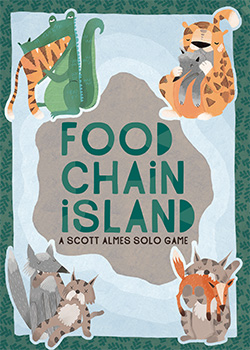
Food Chain Island is an 18 card micro game, designed by Scott Almes, published by micro game masters, Button Shy Games. I’m always amazed just how much a good designer can pull off with only 18 cards.
Setup and gameplay are extremely straightforward, but at the same time exceptionally challenging. Separate out the two Sea Animals and set them aside. These each have a special action that can be used at any time. Then deal out the remaining 16 cards in a four-by-four grid. Each card has a number and animal ranging from a Polar Bear at the top of the food chain (15) down to a mere Plant (0).
Each turn, the player must take one animal and eat another adjacent animal, no more than three numbers lower than it. Then, activate the unique special action of the top animal in the stack. (Usually the one doing the eating.) The actions may be helpful, kinda neutral, or devastatingly bad. It all depends on the situation. The lower numbered animals tend to be more on the positive to neutral end, while higher numbered animals’ abilities tend to lean more towards neutral to challenging.
For example, the Ant (1) moves one animal 1-3 spaces after eating. But the only card lower than it that it can eat is the Plant (0). The Lizard (4) lets you discard one unstacked animal. Super useful to get rid of a card that’s too high or low to be able to eat or be eaten by the animals near it. The Gator (13) doesn’t move onto its prey; instead, the prey is slid under the Gator. Useful when you need to decide between multiple prey, but makes moving the Gator much harder. The Polar Bear (15) cannot eat two turns in a row. This likely has no impact early in the game, but can be game ending in later stages.
I mentioned two sea animals. The Shark and Whale are separate from your main tableau. The Whale lets you move one animal to any other space. The Shark lets you move and eat an adjacent animal of any lower value; this does not count as a turn. While these abilities can be activated (once) at any time, they are strategically likely to be better used near the end of the game. For example, the Shark’s ability doesn’t count as a turn, so the Polar Bear could potentially eat twice without breaking its action rule.
This is the part where I was going to say how ridiculously hard this game is to win, and that’s not untrue. But in checking the rules for something else in this review, I discovered that you actually win the game if you end with one, two, or even three stacks of animals remaining. I actually won a lot more games than I thought I did. Huzzah! I was really wondering if I was just terrible at this game, but it turns out it’s just challenging. With that knowledge, it makes more sense why they included a handful of alternate starting layouts to add to the challenge. I truly was unsure why a harder mode was needed. As it turns out, I was just playing an unofficial extra hard mode.
Food Chain Island is incredibly portable, doesn’t take up a ton of space to play, and runs reasonably quickly. I know I said this in my preview for The Cursed Cat, but who hasn’t been the first to arrive somewhere and needed to kill time? Food Chain Island is a great alternative to doom scrolling your phone. Tons of fun.

If you want to see Food Chain Island played, we streamed a playthrough HERE.
You can find Button Shy Games online at buttonshygames.com or on Facebook at facebook.com/buttonshygames